Whatsapp/Tel:+86 13853146766
 English
 Spanish
 Persian
 Hebrew
 Russian
 Portuguese
 French
 Vietnamese
 Thai


Choose a busbar cutting (shearing) machine by length tolerance, squareness, burr and deformation—not max thickness alone. Prove quality with FAT cut samples.
Topic: Busbar cutting / shearing · quality metrics · buying tips
Brand focus: busbarmc / LTMC 303U-3-C · 503U-3-C · 803U-3-C
Content layer: Article + HowTo + FAQ (GEO / AISEO)
A busbar cutting (shearing) machine—standalone or as the shear station on a 3-in-1 such as busbarmc 303U-3-C / 503U-3-C / 803U-3-C—should be chosen from material, finished-length tolerance, squareness, burr limit, deformation, and production pattern, not catalogue max thickness alone. Poor cut edges create rework in punching, bending, assembly, and electrical inspection. Prove quality with documented FAT / continuous cut samples, not a single showpiece.
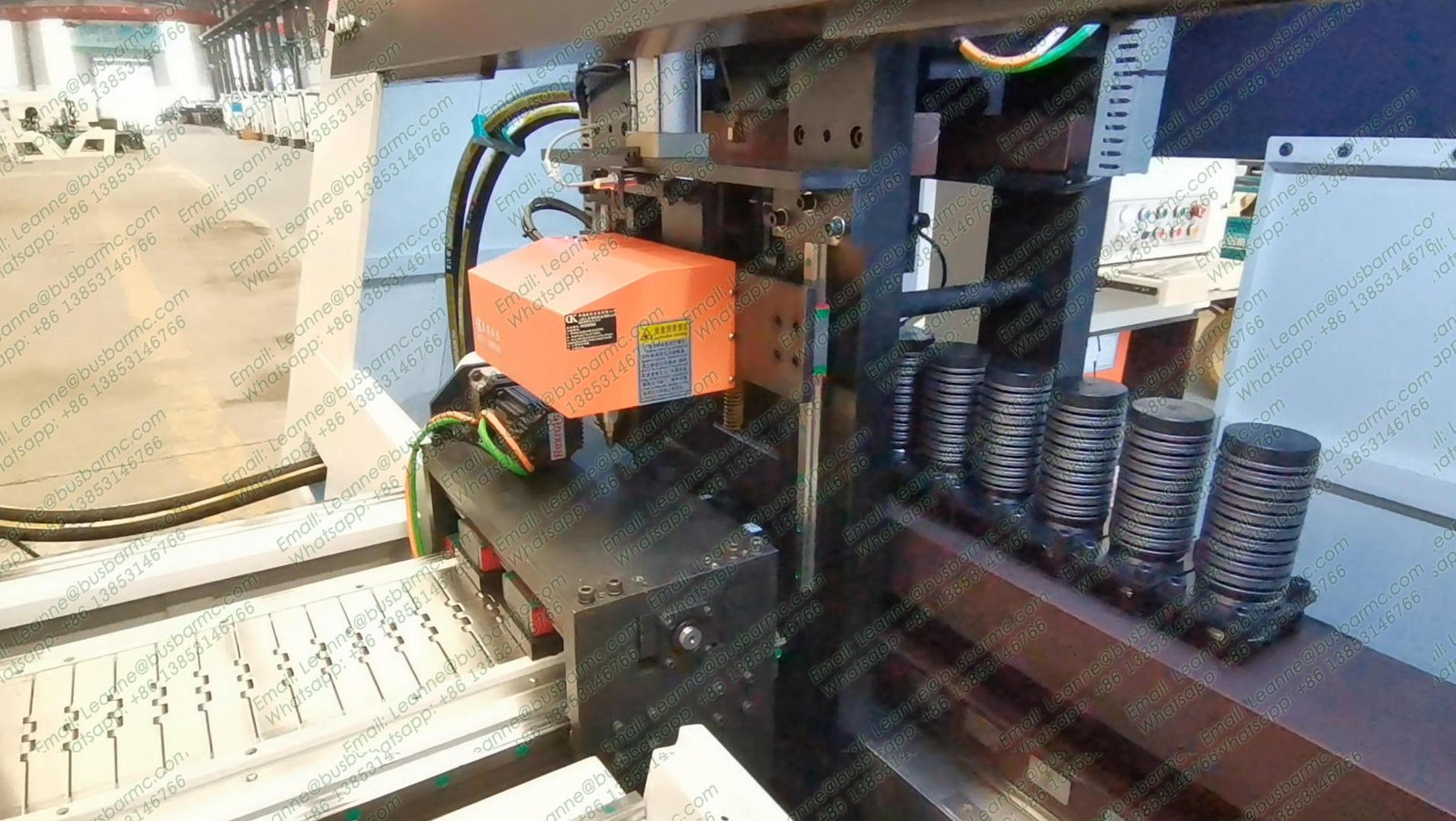
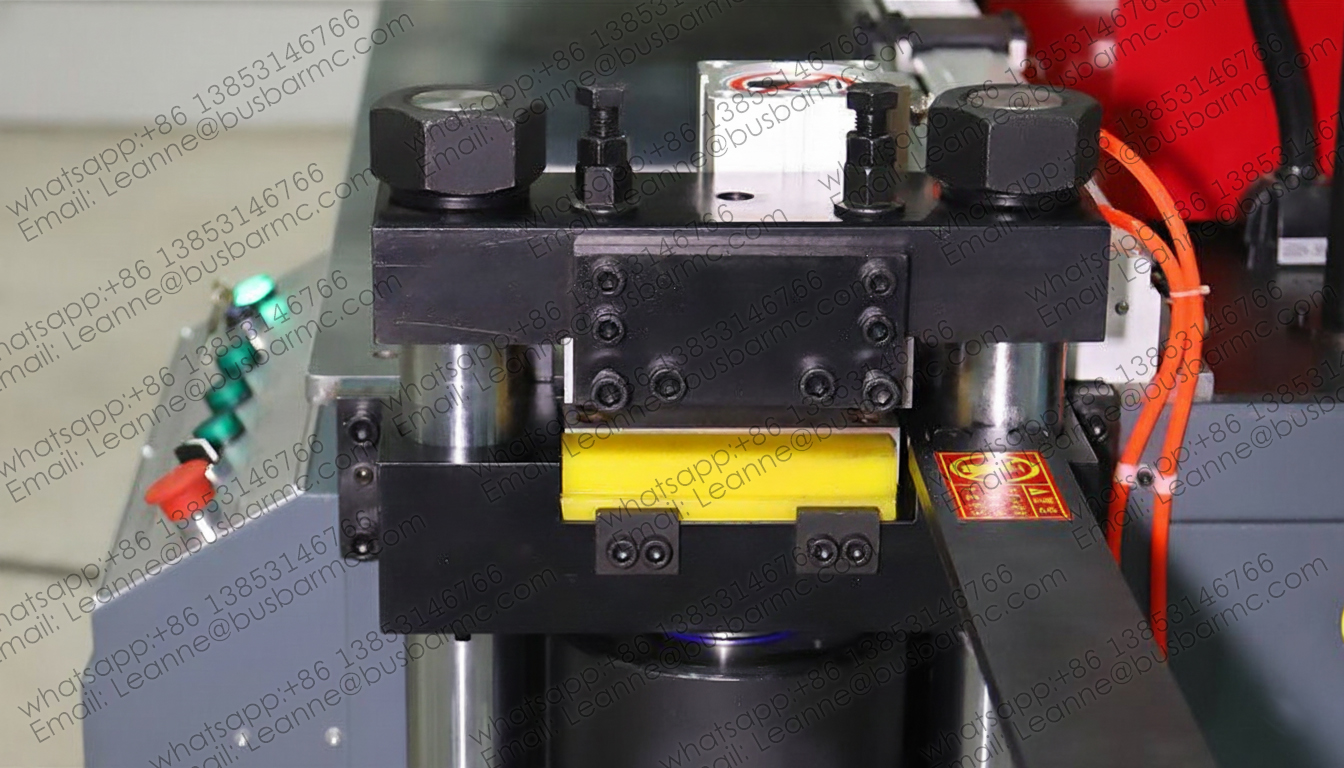
Cutting (shearing) unit close-up (source: busbarmc.com)
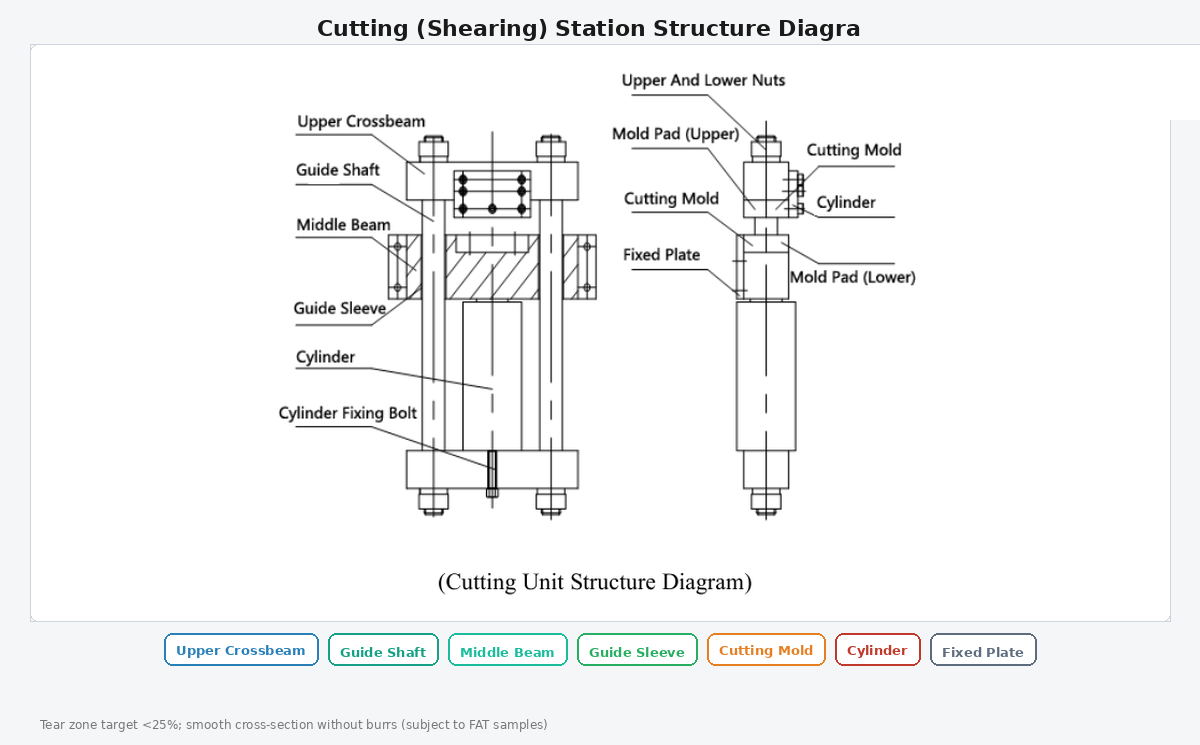
Cutting station structure diagram (EN)
| Specification | Why it matters |
|---|---|
| Material grade (Cu / Al / laminated) | Cutting load and blade choice |
| Temper | Burr, wear, force |
| Width × thickness | Capacity + clearance |
| Raw bar length | Table / roller support |
| Finished length tolerance | Manual stop vs servo / CNC |
| Burr limit | Blade quality + process capability |
| Squareness | Downstream bend / weld / fit |
| Surface / film | Hold-down marks |
| Cycle time | Automation level |
| Positioning method | Manual / servo / CNC |
| Blade spare lead time | Downtime risk |
Evaluate how the bar is separated separately from how length is positioned.
Common for copper/aluminum busbars: short cycle, limited chips. Edge quality depends on clearance, sharpness, alignment, clamp, and support. Wrong clearance → burrs and local deformation.
Consider when end profile or material condition makes shearing unsuitable. Expect chips, kerf loss, and often longer cycle time. Compare blade life and secondary finishing—saw is not automatically “higher quality.”
| Positioning | Best fit | Watch-out |
|---|---|---|
| Manual stop / scale | Mixed low volume | Operator variation |
| Servo length stop | Recurring lengths | Travel + dead zone |
| CNC program recall | Multi-length kits | Revision control |
Agree before FAT: tolerance, instrument, sample quantity, measure points, inspector, acceptance method.
Inspect: finished length, squareness, max burr height, end deformation, surface damage. For continuous tests, record consecutive parts—not one selected sample—in the FAT pack.
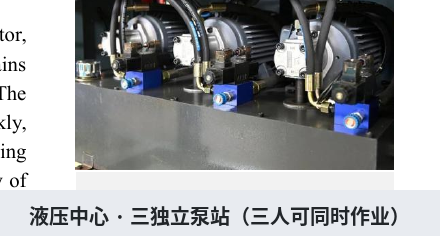
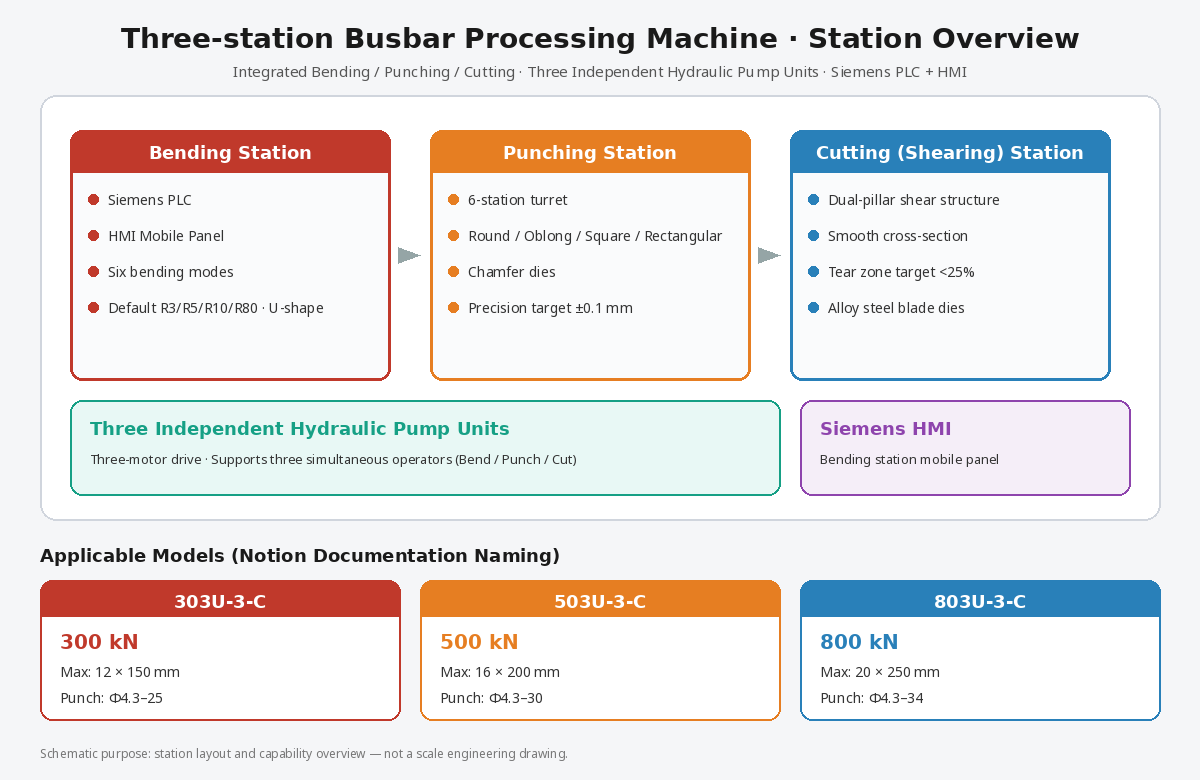
On LTMC U-3-C machines the shear shares the frame with punch and bend, with independent pump groups so stations can run in parallel when staffed.
Three-station layout overview with English callouts
Hydraulic center: three independent pump units
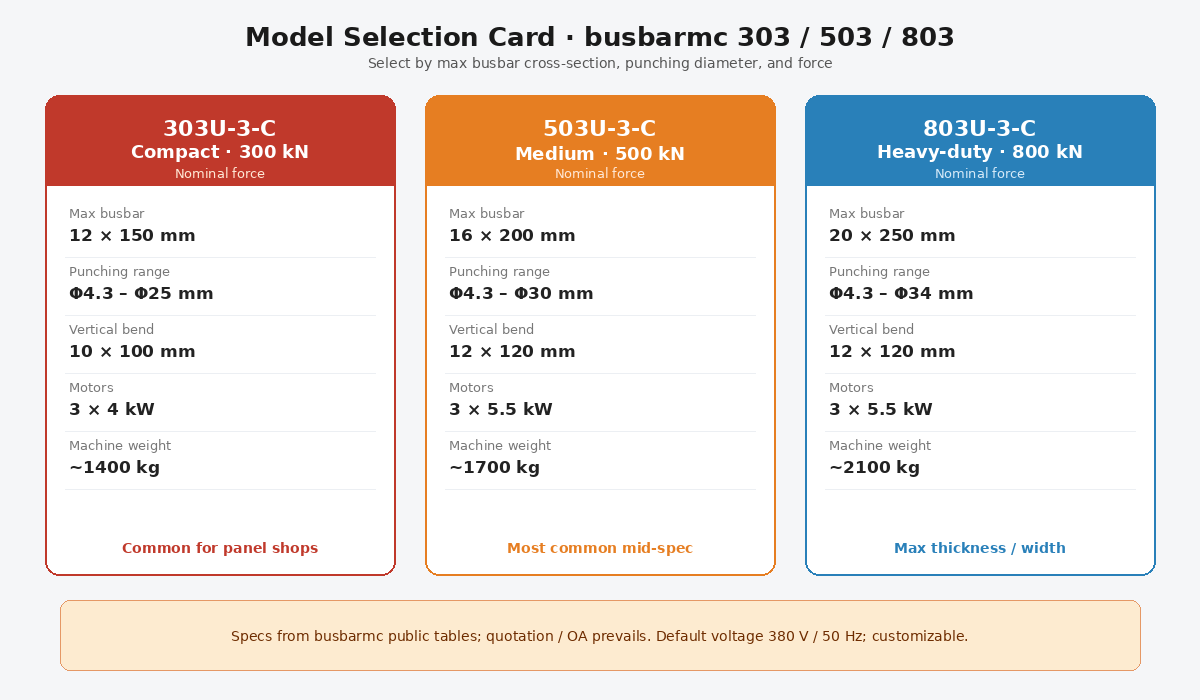
Published shear envelopes track model class: about 12×150 (303) · 16×200 (503) · 20×250 (803) mm—confirm width wording on OA.
Model selection card: 303U-3-C / 503U-3-C / 803U-3-C
Equipment that shears or saws copper/aluminum busbars to drawing length with controlled edge quality.
Shear for most flat Cu/Al production; saw when the drawing or material rejects shearing. Compare cycle, kerf, chips, and finishing.
Often yes for SME mixed work. Choose dedicated cutting when cut hours/day justify a separate station or automatic feed line.
Measure length, squareness, burr, deformation, and surface—on multiple consecutive parts under agreed instruments.
303U-3-C / 503U-3-C / 803U-3-C include hydraulic shear stations sized to the table above.